

Not at all. Sometimes IDGAF is pure attitude, and sometimes it’s a joke between friends. Your friend texts “idgaf what we eat, just feed me.” That’s playful, not angry. Your boss writes “idgaf” in an email. That’s a different story.
The IDGAF meaning in text stays the same, but tone changes everything. Let’s break down what it says, where it came from, and how to use it without causing trouble.
IDGAF Meaning in Text
IDGAF stands for “I don’t give a f*ck.” It’s a blunt way to say you don’t care about something.
People use it to show indifference, confidence, or frustration. The strength of the message depends on who says it and why.
Quick Summary
| Detail | Answer |
| Full form | I don’t give a f*ck |
| Simple meaning | I don’t care at all |
| Type | Internet slang, acronym |
| Tone | Casual, blunt, sometimes rude |
| Best for | Close friends, jokes, venting |
| Avoid in | Work emails, school, formal chats |
In short, the IDGAF meaning in text is “I really don’t care.” It’s stronger than “idk” or “idc” because of the swear word inside.
Background and Origin
IDGAF grew out of early chat rooms and text messaging. People wanted to type fast, so they shortened common phrases.
The phrase itself is much older than the acronym. Saying “I don’t give a damn” or something stronger has been part of English for generations.
Online communities pushed the shortened version into everyday use. You’ll find the term listed in references like Dictionary.com and NetLingo, which track internet and texting slang.
Music helped too. Several artists released songs with this title, which pushed the abbreviation into pop culture and made the IDGAF meaning in text familiar even to people who rarely chat online.
Meaning Across Different Platforms
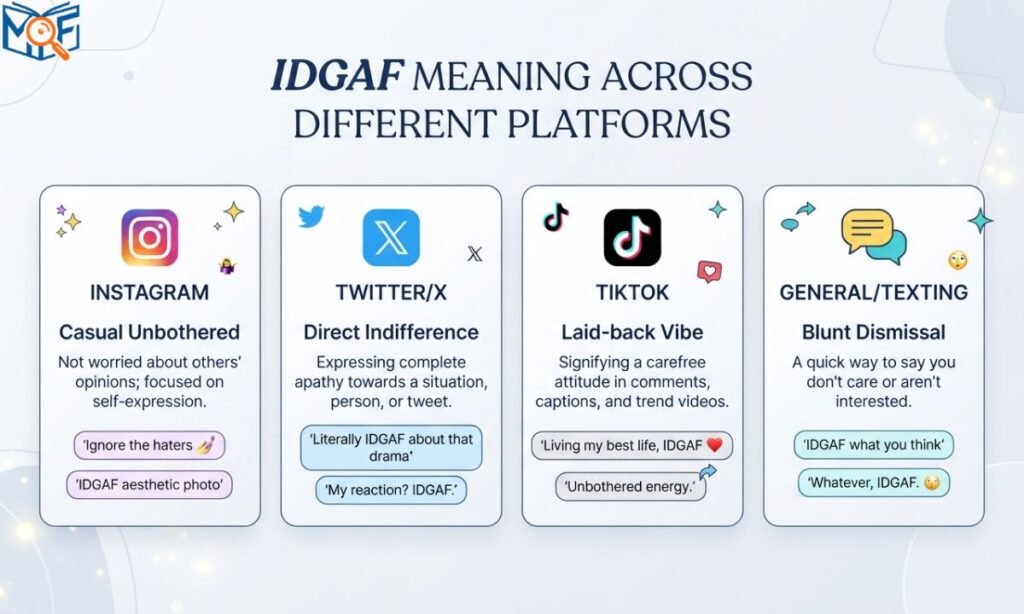
The core meaning doesn’t change, but each app has its own flavor.
| Platform | Typical Use | Tone |
| Private chats, group banter | Casual, personal | |
| Captions, comments, DMs | Confident, stylish | |
| TikTok | Captions, comments, videos | Funny, bold |
| Snapchat | Quick replies, captions | Raw, spontaneous |
| X (Twitter) | Rants, opinions, replies | Sharp, sarcastic |
On WhatsApp, IDGAF shows up in one-on-one chats and friend groups. It often means “I’m easy, you decide.”
Example: “idgaf where we go tonight, just pick.”
On Instagram, people use it in captions to show a carefree vibe. Think beach photos, new haircuts, or bold outfits.
Example: “New look. IDGAF what anyone thinks.”
TikTok
TikTok creators use it in captions and comment replies. It’s often paired with humor or a strong personality.
Example: “Posted it anyway. idgaf 😂”
Snapchat
Snapchat is fast and informal. IDGAF appears in quick replies, usually between close friends.
Example: “idgaf if it rains, we’re still going.”
X (Twitter)
On X, the term often shows up in opinions and arguments. It can sound confident or combative.
Example: “People can hate the movie. IDGAF, I loved it.”
Usage in Different Contexts
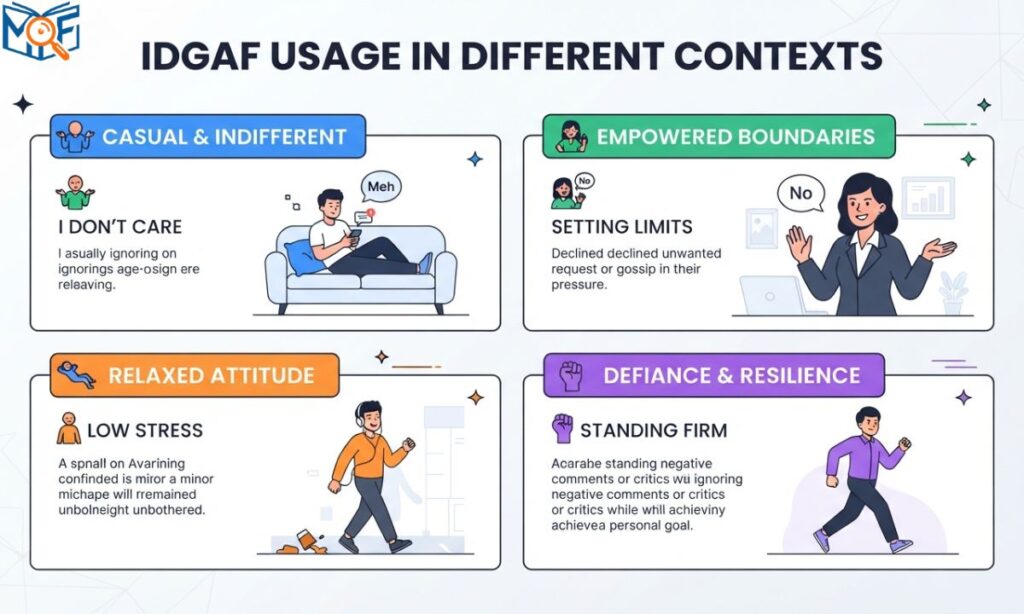
In Text Messages
In private texts, IDGAF can signal indifference, defiance, or frustration. Tone depends on punctuation and emojis.
- Playful: “idgaf, surprise me 😄”
- Annoyed: “I said idgaf. Stop asking.”
- Confident: “idgaf what they say, I’m going.”
On Social Media
Online, IDGAF is often a personality statement. People use it to say they won’t be shaped by other people’s opinions.
Brands rarely use it. Individuals use it a lot.
In Gaming
Gamers use it in voice chats and team messages. It can mean “I don’t care about the loss” or “I’m playing my way.”
Be careful in public lobbies. It can read as toxic when the team is losing.
In Everyday Conversations
Out loud, people say the full phrase more often than the letters. Spoken versions are common among friends and siblings.
“Honestly, I don’t give a f*ck about that drama” is the same idea, just longer.
In Professional Settings
Avoid it. Seriously.
Even in a casual workplace, writing IDGAF can look careless or hostile. Teams use friendlier phrases instead, such as “I’m flexible” or “No strong preference.”
A manager who sees the IDGAF meaning in text applied to a project may assume you’re disengaged. Choose neutral wording and protect your reputation.
Does IDGAF Mean Anything in Other Fields?
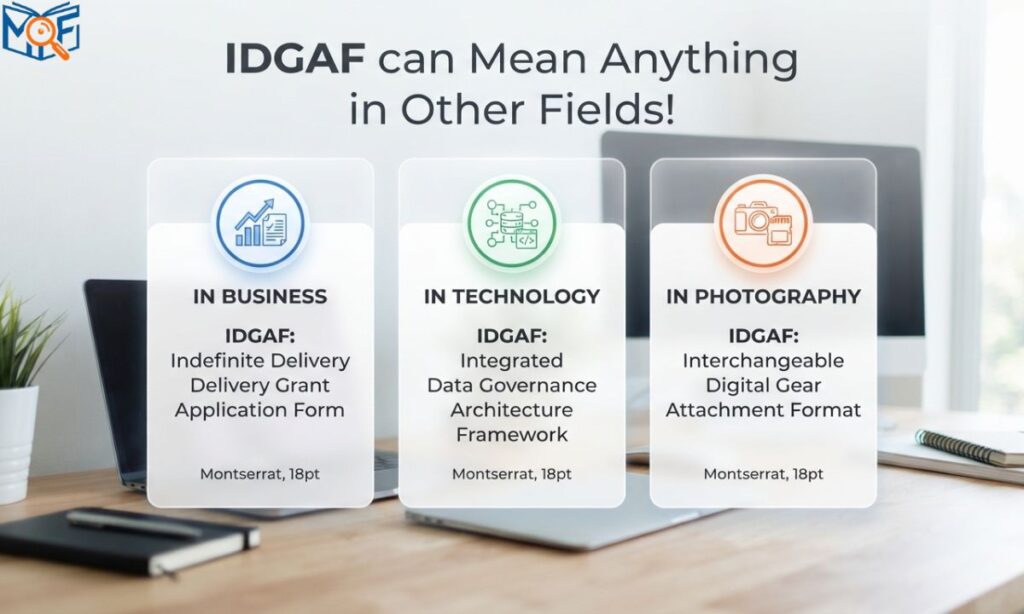
Mostly, no. IDGAF is almost always slang for indifference.
A few niche uses exist:
- Music: Several songs carry the title, so searches can bring up artists and lyrics.
- Fashion and branding: Some small brands use the acronym on merchandise to promote a fearless attitude.
- Online handles: Some people include it in usernames to show personality.
None of these change the main meaning. When someone sends IDGAF in a message, assume indifference first.
Similar Terms and Alternatives
Want the same idea with a softer tone? Try these.
| Phrase | Meaning | Tone |
| IDC | I don’t care | Mild |
| IDK | I don’t know | Neutral |
| Whatever | Doesn’t matter to me | Dismissive or flat |
| No worries | It’s fine with me | Friendly |
| I’m easy | I’m happy with any choice | Polite |
| Not bothered | I’m not affected | Calm |
| Couldn’t care less | I truly don’t care | Strong but clean |
You can also write “It doesn’t matter to me” in more formal chats. It sounds polite and still gets the message across. For related slang, check our guide on IDC meaning in text (internal link).
How to Respond to IDGAF
Your reply depends on the situation. Here’s a simple way to handle it.
- Read the tone. Is it a joke, a vent, or a real brush-off?
- Check the relationship. Friends joke around. Strangers may be hostile.
- Match the energy. Laugh back at a joke. Stay calm if they’re upset.
- Ask a gentle question. “Everything okay?” works well.
- Set a boundary if needed. “Please don’t talk to me like that” is a fair reply.
Quick reply examples:
- Playful: “Ha, fair. I’ll pick then.”
- Concerned: “You seem upset. Want to talk?”
- Firm: “That’s rude. Let’s talk later.”
Common Misconceptions and Mistakes
Many people misread IDGAF. Here are the usual slip-ups.
- “It’s always angry.” No. Plenty of people use it jokingly.
- “It means the same as IDK.” Wrong. IDK means “I don’t know.”
- “It’s fine anywhere.” Not true. Work and school are risky places.
- “It means they hate me.” Usually it means they don’t care about the topic, not about you.
- “It’s only for teenagers.” Adults use it too, mostly with friends.
Another mistake is ignoring context. The IDGAF meaning in text can swing from funny to hurtful depending on who sent it and what came before.
IDGAF vs Similar Expressions
| Expression | Strength | Safe for Work? | Example |
| IDGAF | Very strong | No | “idgaf about the score” |
| IDC | Medium | Sometimes | “idc, you choose” |
| IDK | None (uncertainty) | Yes | “idk what time it starts” |
| IDRC | Medium | Sometimes | “idrc where we sit” |
| Whatever | Mild | Yes, but cold | “Whatever works” |
The big difference is intensity. IDGAF carries emotion, while IDC is calmer and more casual.
Popularity and Trends Over Time
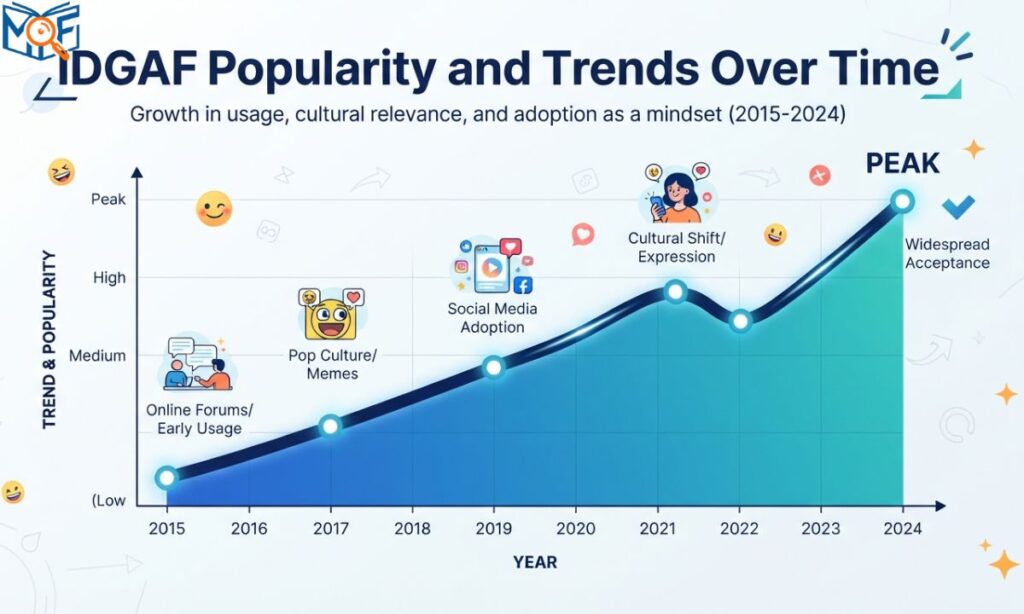
IDGAF has stayed popular for years, which is rare for slang. Most terms fade fast, but this one keeps coming back.
Its staying power comes from a simple appeal. People like having a short, punchy way to say “I’m not worried about your opinion.”
Search interest tends to rise whenever a new song, meme, or viral post uses it. Younger users keep it alive, though older users have picked it up as well.
If you track trends, the IDGAF meaning in text is a good example of slang that shifted from edgy to mainstream. It’s still bold, but far less shocking than it once was.
Relevance in Online Conversations and Dating Apps
On dating apps, IDGAF can go wrong quickly. A first message with that term may suggest you’re careless or uninterested.
Later in a chat, it can show confidence. For example, “idgaf about the small stuff, I just want good vibes” can sound relaxed.
Here are quick dating app tips:
- Skip it in opening messages.
- Use it only after you’ve built some rapport.
- Add a smiley or joke if you want to soften it.
- Don’t use it to dismiss someone’s feelings.
In online forums and group chats, the same rules apply. When in doubt, pick a friendlier phrase. Once you understand the IDGAF meaning in text, you can decide when the bluntness helps and when it hurts.
Frequently Asked Questions
What does IDGAF mean in texting?
It means “I don’t give a f*ck.” It shows you don’t care about something.
Is IDGAF rude?
It can be, depending on tone. It’s fine with friends but harsh with others.
Can I use IDGAF at work?
No, avoid it at work. It sounds unprofessional and careless.
Is IDGAF the same as IDC?
Not exactly. IDGAF is stronger and more emotional than IDC.
Is IDGAF popular on social media?
Yes, it’s very common. People use it on TikTok, Instagram, X, and Snapchat.
Can teenagers use IDGAF?
It contains a swear word. Parents and schools may not approve.
What does IDGAF mean in a text message?
It means “I don’t give a f*ck.” It’s a blunt way to say you don’t care.
What does IDGAF stand for on social media?
It stands for “I don’t give a f*ck.” People use it to show confidence or indifference.
Is IDGAF a bad word?
The acronym itself isn’t a swear word. But it stands for one, so many people treat it as rude.
Conclusion
IDGAF is a short phrase with a strong message. It says “I don’t care,” and it says it loudly. Friends may find it funny, while strangers may find it harsh. Context, tone, and audience decide how it lands.
Now you know the IDGAF meaning in text and how to use it wisely. Use it with people who get your humor, and skip it where respect matters. Want to decode more slang, acronyms, and texting terms? Keep exploring the other meanings on our website.

John Julian is the founder and head wordsmith at MeaningFacts.com, a dedicated digital resource for word origins, definitions, and cultural linguistics. With over 5 years of experience as a lexicographer and content researcher, John Julian specializes in breaking down complex etymologies into accessible, engaging stories.