
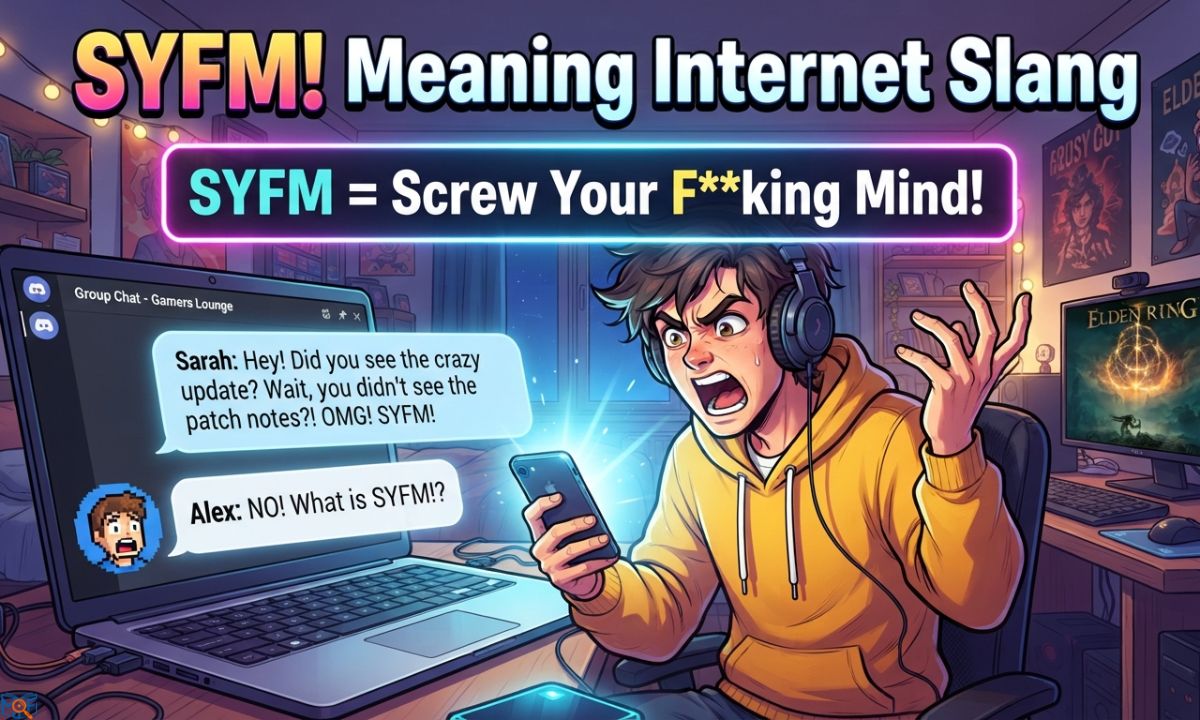

If you’ve seen “SYFM” pop up in a group chat, a comment section, or a gaming lobby, you’re probably scrolling for answers right now. It looks random at first. Then someone explains it, and suddenly half your old conversations make a lot more sense.
SYFM is short for “Shut Your F*ing Mouth.” It’s blunt, it’s rude on paper, and yet people use it constantly without meaning real anger at all. That gap between what it literally says and what it actually means is exactly why so many people search for it.
This guide breaks down SYFM Meaning Internet Slang, including where it comes from, how tone changes its meaning, how it appears across Snapchat, TikTok, Twitter/X, and gaming chats, and how you can tell a joke from a genuine warning to back off.
SYFM Meaning in Text: The Simple Answer
- SYFM stands for “Shut Your F*ing Mouth.”
It’s an internet acronym used to tell someone to stop talking, immediately. That’s the literal translation. In practice, though, SYFM rarely means what it says word for word.
Depending on who sends it and how, SYFM can express:
- Genuine anger or frustration
- Playful teasing between close friends
- Shock or disbelief (“no way, stop lying”)
- A sarcastic reaction to something ridiculous
Think of it the way you’d think of “shut up” in spoken English. Said with a laugh, it means, “I can’t believe you.” Said through gritted teeth, it means something very different. Understanding the SYFM Meaning Internet Slang depends on the context and tone of the conversation. SYFM works the same way—the words don’t change, but the feeling behind them does.
Origin and History of SYFM Slang
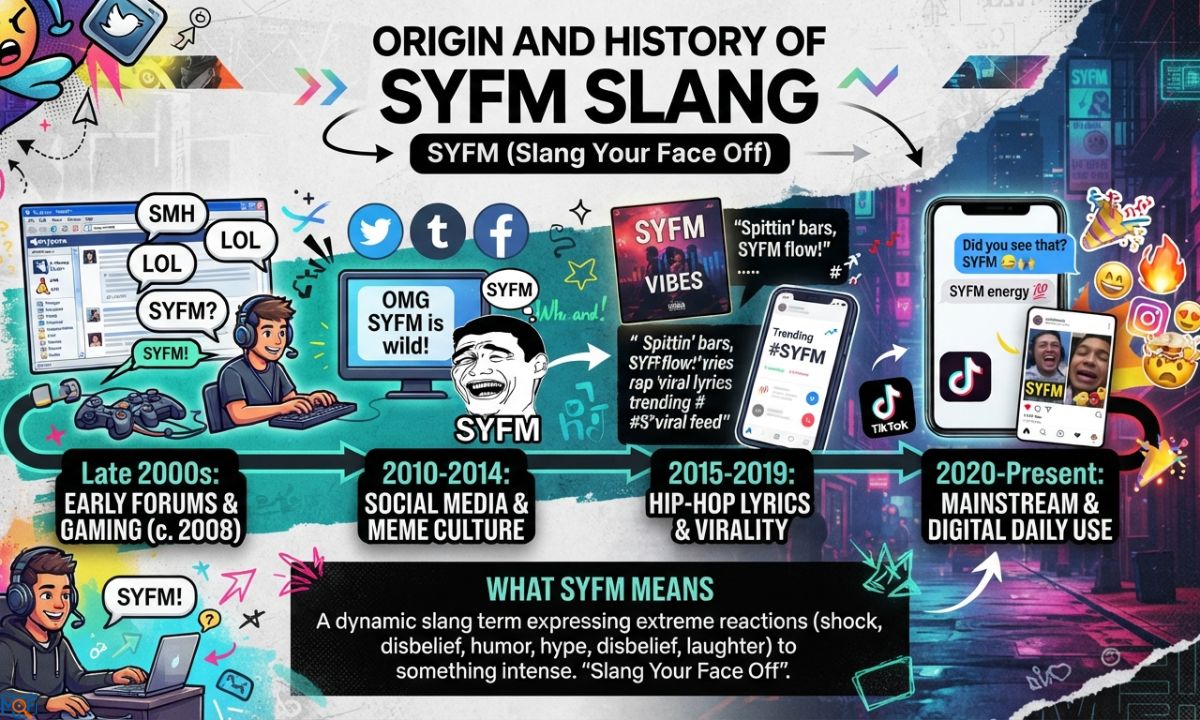
SYFM didn’t appear overnight. It grew out of the same texting habits that gave us STFU, LOL, and IDC — early SMS culture, where character limits and slow typing pushed people toward acronyms.
A few things fueled its spread:
- Character limits on early phones made short abbreviations more practical than full sentences.
- Gaming and chatroom culture in the 2000s and early 2010s normalized blunt, fast-typed reactions during matches and group chats.
- Meme culture on TikTok, Instagram, and Twitter/X picked it up later, giving it a second life among younger users who use it more for comedic timing than actual hostility.
By the mid-2010s, SYFM had moved from niche gaming chats into mainstream texting. Today it sits alongside acronyms like SMH and FML as part of everyday informal typing, even though its literal meaning is still fairly harsh.
Is SYFM Always Offensive? Understanding Tone and Context
No — and this is the part people get wrong most often. SYFM is not automatically an insult. It’s a phrase that borrows its power from context.
| Situation | Likely Meaning |
| Close friend reacting to gossip | Playful disbelief (“no way!”) |
| Random person during an argument | Genuine hostility |
| Gaming chat after a wild play | Excited reaction, not literal |
| Coworker in a formal chat | Almost always inappropriate |
| Text with a laughing emoji attached | Joking, not serious |
Because text strips out tone of voice, the same three letters can land as a joke or an insult depending entirely on the relationship and the moment.
How to Know If SYFM Is Playful or Serious
A few quick signals usually settle it:
- Check the relationship. Close friends and inside jokes lean playful. Strangers or acquaintances lean serious.
- Look at the punctuation and emojis. A 😂, 💀, or “lol” attached almost always signals a joke.
- Read the conversation before it. SYFM reacting to a funny story is different from SYFM after a disagreement.
- Notice capitalization. ALL CAPS often signals real frustration; lowercase and casual phrasing usually signals a joke.
- Trust your gut on the history. If the person has never been aggressive with you before, it’s probably not the moment they started.
When in doubt, it’s fine to just ask. A simple “wait, are you being serious?” clears up more confusion than trying to decode tone from three letters alone.
SYFM Meaning on Social Media Platforms
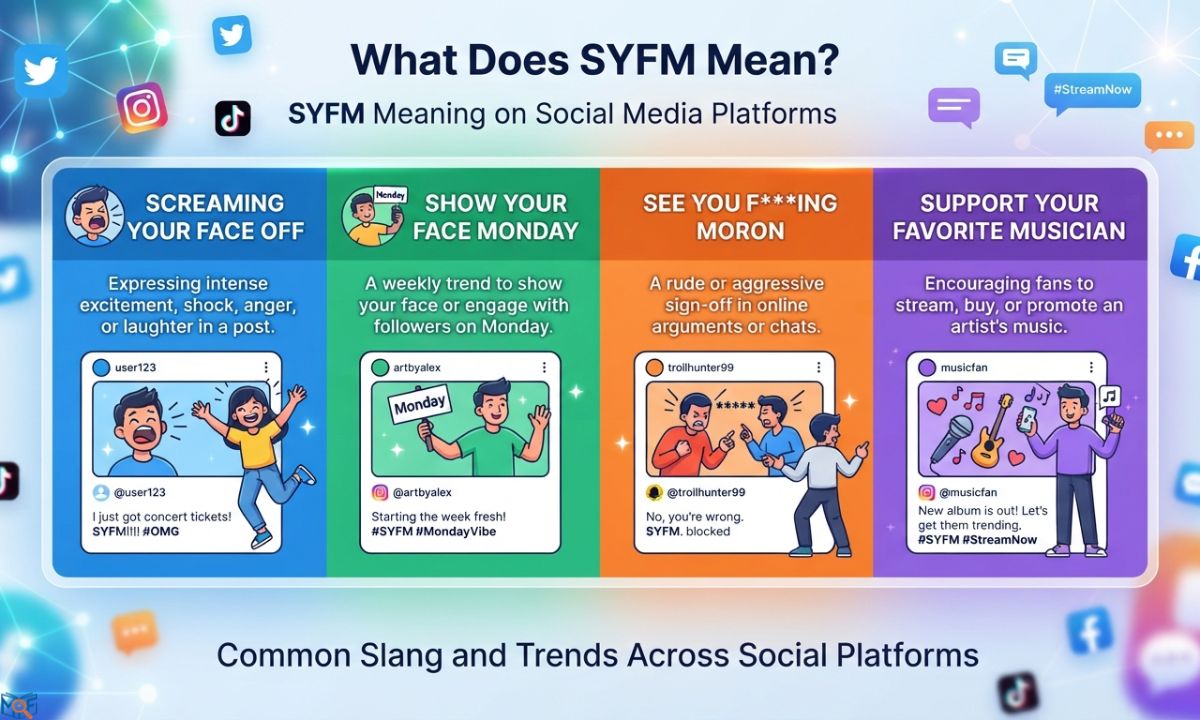
SYFM doesn’t behave the same way on every app. Each platform has its own culture around how blunt slang like this gets used.
SYFM on Snapchat
On Snapchat, SYFM shows up mostly in private chats and story replies, often reacting to a piece of gossip, a surprising Snap, or a funny screenshot. Because Snapchat conversations tend to be between close friends, SYFM here usually leans playful rather than hostile.
SYFM on Instagram and TikTok
On Instagram and TikTok, SYFM appears frequently in comment sections and reply threads, often reacting to a shocking clip, a plot twist in a video, or an unbelievable claim. It functions almost like a stronger version of “no way” or “stop it,” and creators sometimes use it intentionally for comedic effect.
SYFM on Twitter/X
On Twitter/X, SYFM tends to show up in reply threads and quote-tweets, reacting to hot takes, unexpected news, or bold opinions. Given the platform’s faster, more combative reply culture, it’s more likely here to carry a genuine edge than it would in a private DM.
SYFM in Gaming Chats
In gaming voice and text chats, SYFM is extremely common, especially after an unexpected kill, a clutch play, or a taunt between teammates or opponents. In competitive gaming spaces, it’s often closer to trash talk than a real request to stop talking, and most players don’t take it personally.
SYFM in Different Types of Conversations
Where SYFM lands depends heavily on the type of conversation it’s dropped into.
Among Close Friends
Between close friends, SYFM often works like an inside joke. It’s a fast way to react to gossip, a funny confession, or an outrageous story, and it usually comes packaged with laughing emojis or all lowercase, casual phrasing.
In Arguments or Conflicts
During an actual disagreement, SYFM shifts meaning fast. Without the cushion of a joking tone, it reads as dismissive and confrontational, and it can escalate tension rather than defuse it. This is the context where the literal, harsher meaning of the phrase is most likely to apply.
In Professional or Formal Chats
SYFM has no place in professional communication. Slack, Teams, work email, or any formal chat is the wrong setting for it, regardless of intent, since the profanity alone makes it inappropriate for workplace tone.
Real-Life Examples of SYFM in Texts

A few examples of how SYFM plays out in everyday conversations:
- Friend group chat: “wait he actually said that to her face 💀” → “SYFM no he did NOT”
- Gaming lobby: “bro just 1v3’d the whole team” → “SYFM that’s actually insane”
- Heated argument: “you always do this” → “SYFM, I’m done talking about this”
- Reacting to a plot twist: “the ending completely changes the whole movie” → “SYFM don’t spoil it 😭”
Notice how the first three examples read as excitement or disbelief, while the argument example reads as a genuine shutdown. Same acronym, very different energy.
SYFM vs. Similar Slang Terms (STFU, SYBAU, and More)
SYFM belongs to a small family of blunt, tell-someone-to-stop-talking acronyms. Here’s how they compare:
| Term | Full Meaning | Typical Tone |
| SYFM | Shut Your F*ing Mouth | Playful or aggressive, depends on context |
| STFU | Shut The F*ck Up | Usually more forceful and direct |
| SYBAU | Shut Your B*tch A*s Up | Confrontational, often used in conflict |
| SMH | Shaking My Head | Disappointment, not a command |
| FR | For Real | Agreement or emphasis, not related in meaning |
The key difference is intensity and function. STFU and SYBAU tend to read as sharper and more confrontational by default, while SYFM has more flexibility — it swings between joking and serious more easily than its harsher cousins.
How to Respond to Someone Who Texts You SYFM
How you respond depends on the read you get from context:
- If it seems playful: Match the energy. A laughing reply or a “wait fr??” keeps the tone light.
- If it seems serious: Give the conversation space. Responding with more heat usually escalates things rather than resolving them.
- If you’re unsure: Ask directly. “Are you being serious right now?” is a simple way to clear up tone without guessing.
- If it feels disrespectful: You’re allowed to say so. Setting a boundary about language, even in casual texting, is reasonable.
When You Should Avoid Using SYFM
A few situations where SYFM is best left out of the conversation entirely:
- Professional settings, including work chats, emails, and client communication
- Conversations with people you don’t know well
- Formal or first-time interactions
- Any moment where the other person seems genuinely upset
- Family group chats, unless you know the tone is welcomed there
Because SYFM contains implied profanity, it’s also worth skipping around younger relatives, teachers, or anyone who might not appreciate the language, regardless of your intended tone.
Common Misconceptions About SYFM

A few myths worth clearing up:
- “It’s always an insult.” Not true. Context and relationship matter more than the words themselves.
- “It only means agreement or excitement.” Also not accurate. It can genuinely signal anger in the right situation.
- “Everyone already knows what it means.” Plenty of people encounter it for the first time and have no idea, which is exactly why it keeps getting searched.
- “It’s brand new slang.” SYFM has roots going back to early 2000s texting and chatroom culture, not a recent invention.
Why Internet Slang Like SYFM Continues to Spread
Text and chat strip out tone of voice, facial expressions, and pauses, so users fill that gap with acronyms, emojis, and punctuation choices instead. Understanding the SYFM Meaning Internet Slang helps explain why this abbreviation has become so popular in online conversations.
SYFM caught on because it packs a strong reaction into four letters, which fits the pace of modern texting, gaming chats, and comment sections. As long as digital communication keeps favoring speed over full sentences, slang like SYFM will keep evolving, spreading, and picking up new meanings depending on where it shows up next.
FAQs
What does SYFM mean in a text?
SYFM means “Shut Your F*ing Mouth.” It’s used to react strongly to something surprising or to tell someone to stop talking.
Is SYFM a bad word?
SYFM isn’t a word itself, but it stands for a phrase containing profanity, so it’s considered inappropriate for formal or professional settings.
What does SYFM mean on Snapchat?
On Snapchat, SYFM is usually a playful reaction to gossip or a surprising Snap, sent between close friends.
Is SYFM the same as STFU?
No. SYFM and STFU are similar but not identical. STFU tends to sound more forceful, while SYFM shifts more easily between joking and serious depending on tone.
What does SYFM mean in gaming?
In gaming chats, SYFM is common trash talk after an impressive or unexpected play, and it’s rarely meant as a literal command.
Conclusion
So, what does SYFM mean? It stands for “Shut Your F*ing Mouth,” but the real meaning always depends on tone, relationship, and context. Among friends, it’s often just a loud reaction. In an argument, it can carry real weight.
Internet slang keeps shifting shape as new platforms and communities pick it up. If you came across SYFM in a text and wanted a clear answer, hopefully this cleared it up. Keep exploring the site for more slang breakdowns like this one.

John Julian is the founder and head wordsmith at MeaningFacts.com, a dedicated digital resource for word origins, definitions, and cultural linguistics. With over 5 years of experience as a lexicographer and content researcher, John Julian specializes in breaking down complex etymologies into accessible, engaging stories.